Roughly nine out of ten new bettors place their first wager without understanding what the odds in front of them actually represent. That single gap in knowledge explains why so many people lose money quickly, get discouraged, and walk away from something that could have been an enjoyable, controlled form of entertainment. The problem isn't bad luck. It's a missing foundation.
This beginner's guide to online betting exists to fix that foundation before you place a single stake. Setting up a betting account takes minutes, but understanding what happens after you fund it takes real preparation. Platforms such as goldbet-nigeria.com have made registration and game selection straightforward, yet the technical ease of signing up often hides how much judgment is required afterward - reading odds correctly, spotting fair games, and telling real analysis apart from noise dressed up as expert prediction.
By the end of this guide, you'll know how to open an account correctly, recognize which games actually give you a fair shot, interpret odds like someone who has done it for years, and separate trustworthy sports predictions from recycled guesswork. None of this requires special talent. It requires knowing what to look for.
Getting Started: Creating Your Online Betting Account
How do I create an account
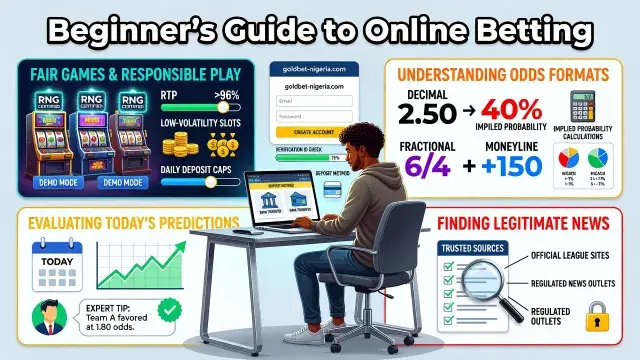
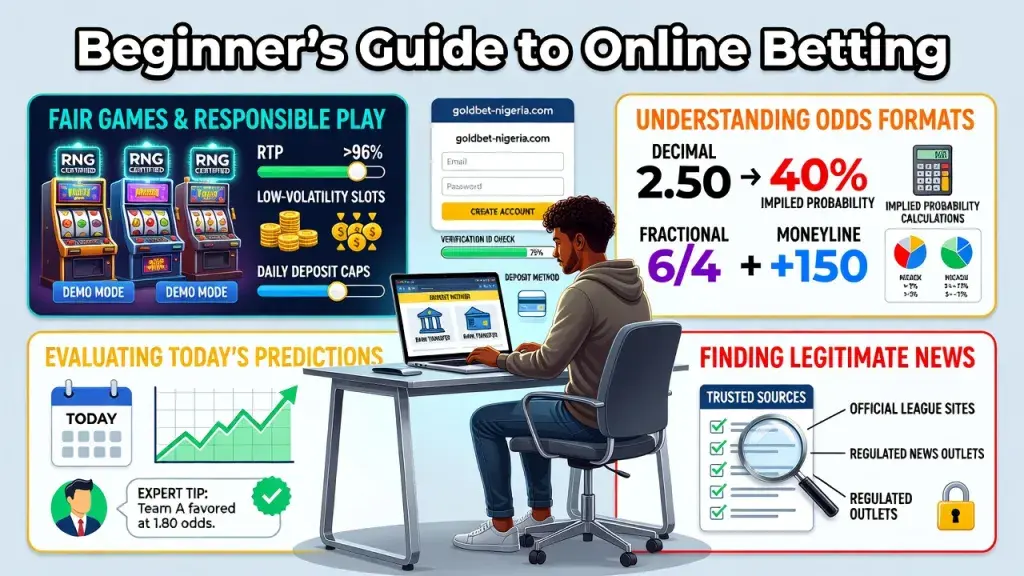
Opening an account on a licensed betting platform generally follows the same pattern regardless of which operator you choose. You provide an email address, choose a username and password, and confirm basic identity details - full name, date of birth, and country of residence. Most platforms then ask for identity verification, usually a government-issued ID and sometimes proof of address, before you can withdraw winnings. This step exists to comply with anti-fraud and age-verification regulations, not to slow you down unnecessarily.
After verification, you'll link a payment method - bank transfer, card, or a mobile payment option, depending on your region. It's worth reading the minimum deposit requirements and any welcome terms before funding the account, since bonus conditions often carry wagering requirements that affect how and when you can withdraw.
Setting Up Responsible Limits from Day One
Before placing any bet, set a deposit limit or session boundary. Reputable platforms offer built-in tools for this - daily deposit caps, self-exclusion periods, and loss limits. Beginners who skip this step tend to chase losses later, which is precisely the behavior these tools are designed to prevent. Treat this setup step as part of account creation, not an optional afterthought.
Exploring the Games: Where to Look and What to Choose
Where can I find new online entertainment games
Licensed betting and gaming platforms regularly update their libraries, and the "new releases" or "recently added" section is usually the fastest way to see what's fresh. Game providers push new titles monthly, ranging from updated slot mechanics to new variations of table games and virtual sports. Following a platform's official announcements or newsletter is a reliable way to stay current without relying on third-party rumor sites that often list outdated or region-locked games.
How can beginners choose entertainment betting games
Choice paralysis is real when a platform lists hundreds of titles. Beginners do best by narrowing decisions to three factors: return-to-player (RTP) percentage, volatility, and minimum stake. A game with a published RTP above 96% and low-to-medium volatility gives more frequent, smaller wins - a gentler learning curve than high-volatility games that swing between long dry spells and large payouts.
- Check the RTP percentage listed in the game's information panel before playing.
- Start with demo or free-play modes to understand mechanics without risking money.
- Favor games from established, licensed software providers rather than obscure, unbranded titles.
- Set a stake size you're comfortable repeating for at least 50-100 rounds, since betting games are built around volume.
Are online pokies fair
Fairness in online pokies comes down to certification, not intuition. Legitimate pokies run on random number generators (RNGs) that are independently tested by third-party auditing firms, and licensed platforms display this certification, along with the RTP rate, somewhere in the game's details. A fair pokie doesn't guarantee you'll win - it guarantees that outcomes are statistically random and not manipulated in the platform's favor beyond the built-in house edge. If a site doesn't disclose RTP figures or licensing information, that absence is itself a warning sign.
Understanding the Numbers: How to Read Sports Prediction Odds
How to read sports prediction odds
Odds come in three common formats: decimal, fractional, and moneyline. Decimal odds, common outside North America, show your total return per unit staked - odds of 2.50 mean a $10 bet returns $25 total, including your stake. Fractional odds, like 6/4, show profit relative to stake: a $4 bet wins $6 profit. Moneyline odds use positive and negative numbers to indicate underdogs and favorites respectively. Learning to convert between these formats quickly helps you compare value across different platforms and markets.
Implied Probability and Why It Matters
Every set of odds encodes a probability estimate. Converting decimal odds to implied probability is simple: divide 1 by the decimal odds and multiply by 100. Odds of 2.50 imply a 40% chance of that outcome, according to the bookmaker's model. Comparing implied probability against your own assessment of a match is the core skill behind identifying value bets rather than just picking favorites.
Evaluating Predictions: What to Trust and What to Skip
What are today's sports predictions
Today's sports predictions are forecasts - generated by analysts, statistical models, or a combination of both - estimating the likely outcome of matches scheduled for that day. They typically include a predicted winner, sometimes a scoreline or margin, and a confidence indicator. Quality predictions are transparent about the reasoning behind them: recent form, head-to-head history, and situational factors, rather than a bare assertion with no supporting logic.
What factors influence today's match predictions
Reliable predictions weigh several inputs simultaneously rather than relying on a single stat. Recent team form, injury reports, home versus away performance, weather conditions for outdoor sports, and historical head-to-head results all shift the probability of an outcome. Motivation matters too - a mid-table team with nothing left to play for often performs differently than one fighting relegation or chasing a title.
- Current form over the last five to ten matches
- Player availability, including injuries and suspensions
- Home-field advantage and travel fatigue for away teams
- Tactical matchups between opposing playing styles
- Historical results in similar fixtures or competitions
Are free betting predictions worth using
Free predictions vary enormously in quality. Some come from analysts who publish their reasoning openly and maintain a visible track record; others are generated to drive traffic with no accountability for accuracy. The useful ones explain their logic and disclose past performance honestly, including losses. Treat any free prediction that promises guaranteed wins or refuses to show a track record as entertainment at best, not analysis. Cross-referencing a free prediction against your own reading of the factors above is a far better approach than following it blindly.
Staying Informed: Finding Legitimate Sports Entertainment News
Where to find legitimate sports entertainment news
Established sports media outlets with named journalists, editorial standards, and a history of accurate reporting remain the most dependable sources. Official league websites, team communications, and accredited broadcasters typically confirm injury news, lineup changes, and fixture updates faster and more accurately than unverified social media accounts. When a piece of betting-related news seems significant enough to influence a wager, check whether at least two independent, reputable outlets report the same information before acting on it.
Spotting Unreliable Sources
Red flags include anonymous authorship, sensational headlines disconnected from the article's actual content, and sites that mix news with aggressive betting advertisements without disclosure. Legitimate outlets separate editorial content from promotional material and correct errors publicly when they occur. If a "breaking" story about an injury or lineup change appears nowhere else, treat it as unconfirmed rather than actionable.
Frequently Asked Questions
Do I need to verify my identity before placing my first bet?
Most licensed platforms allow you to deposit and bet before full verification, but they require identity documents before processing any withdrawal. Submitting these documents early, right after account creation, prevents delays later when you want to cash out winnings.
What's the difference between volatility and RTP in betting games?
RTP measures the average percentage of wagered money a game returns to players over the long run, while volatility describes how often and how large the payouts are along the way. A high-RTP, low-volatility game pays smaller amounts more frequently; a high-volatility game pays rarely but with larger sums when it does.
Can I trust odds that look significantly better on one platform than another?
Odds differences between platforms are normal and reflect each bookmaker's own risk model and betting volume, not necessarily an error. Comparing odds across two or three licensed platforms before betting is a legitimate way to find better value, provided each platform is properly regulated.
How do I know if a sports prediction source has a real track record?
Credible prediction sources publish their past picks alongside outcomes, including their losses, usually organized by date or competition. If a source only highlights its wins or deletes unsuccessful predictions, its stated accuracy rate cannot be verified and should be treated with skepticism.
Is it normal to lose money when starting out with online betting?
Short-term losses are common even for experienced bettors, since betting outcomes involve genuine uncertainty regardless of preparation. The goal of a beginner's guide to online betting is not to eliminate losses but to ensure decisions are informed, limits are respected, and losses stay within amounts you've deliberately chosen to risk.
Should I rely on a single prediction before placing a bet?
A single prediction, free or paid, should never be the sole basis for a wager. Cross-checking the reasoning behind a prediction against current form, injury news from legitimate sources, and the odds themselves gives a far more reliable picture than any one forecast alone.