Two dice, three betting zones, and a result that changes every few seconds - that's the entire engine behind one of the most enduring gambling games ever adapted for home play. No cards to shuffle, no chips to count into complicated stacks, no rulebook thick enough to intimidate a newcomer. Just a number between two and twelve, decided in an instant, and a group of people reacting to it in real time.
That immediacy explains why this game keeps resurfacing at house parties, festival stalls, and college dorm rooms decades after it first appeared at street fairs and small-stakes gambling tables. Anyone learning how to play 7up 7down game for the first time usually needs less than five minutes to understand the mechanics, which is precisely why it spreads so easily through friend groups. If you want to see the physical setup and dice mechanics in motion before trying it yourself, how to play 7up7down is demonstrated step by step in a format that makes the visual logic click faster than text alone. Once the basic pattern registers, most players start inventing their own house rules within the first few rounds.
What follows is a complete breakdown of the rules, the betting logic, and the social variations that have kept this game alive across generations of casual gamblers. You'll find the official structure, home-friendly adaptations, and the drinking-game twists that turn a quiet dice round into the loudest part of the night.
What Is 7 Up 7 Down and Why It's So Popular
The game traces its roots to informal betting tables where a simple proposition - will the dice total more than seven, less than seven, or exactly seven - proved enough to hold a crowd's attention for hours. Unlike poker or blackjack, there's no card-counting skill to master and no bluffing to read. The dice decide everything, and that transparency is part of the appeal.
Its staying power comes from a rare combination: it's fast enough to keep a group engaged, simple enough for a first-time player to join mid-session, and flexible enough to scale from a two-player tabletop match to a twelve-person party circle. Regional fairs and small gambling halls have used it for generations as an entry-level betting game, precisely because the barrier to understanding it is close to zero.
Origins and Background of the Game
Dice-based totaling games have existed in various forms across gambling cultures for centuries, and this particular structure - betting on a range above or below a fixed midpoint - reflects a format found in multiple traditional wagering games. The "seven" itself holds special weight because it's the most statistically frequent outcome when rolling two standard six-sided dice, which naturally made it the pivot point around which the entire betting structure was built.
Why It's a Favorite for Group Gatherings
The game rewards spectators as much as participants. Even people who aren't betting tend to lean in when the dice are mid-air, because the outcome affects everyone at the table simultaneously. That shared tension is difficult to replicate in turn-based games where only one player acts at a time.
Basic Equipment You Need to Play
- Two standard six-sided dice
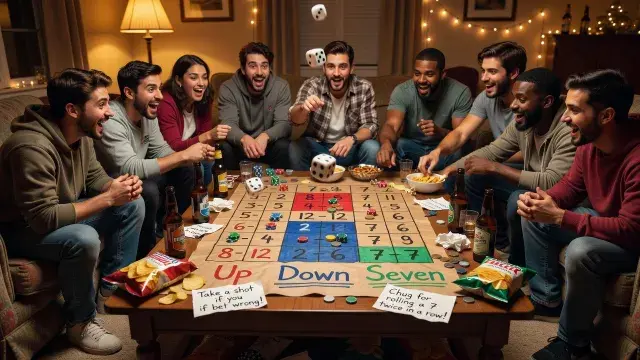
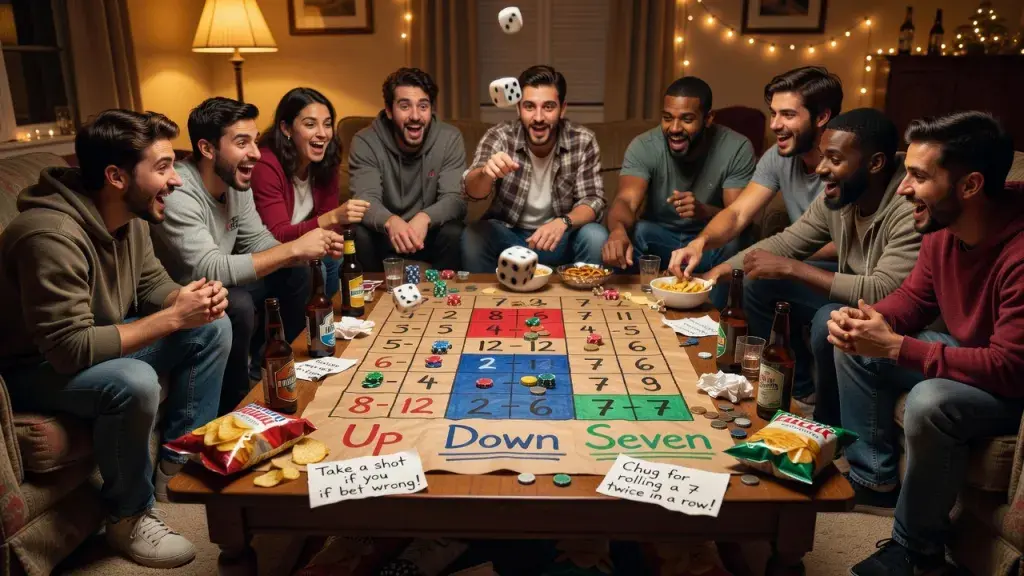
- A flat surface or a simple mat divided into three betting sections: Up, Down, and Seven
- Chips, coins, or any small tokens to represent bets
- A designated dealer to manage the dice and payouts
7 Up 7 Down Rules Explained Step by Step
The 7up 7down rules follow a simple three-way structure. Before each roll, players place their bets in one of three zones: "Up" (the dice total will be 8 or higher), "Down" (the total will be 6 or lower), or "Seven" (the dice will land on exactly 7). Once bets are placed, the dealer rolls both dice, and the total determines which zone wins.
What makes the format interesting is the asymmetry in odds. Betting on "Up" or "Down" gives you a wider range of winning numbers, but a smaller payout. Betting on "Seven" is a long shot with fewer combinations that produce it, so the reward for hitting it is proportionally larger. Understanding this trade-off is the foundation of every session, and it's the first thing experienced players explain when teaching newcomers the 7up 7down game instructions.
Understanding the Betting Zones (Up, Down, Seven)
"Up" covers totals from 8 to 12, "Down" covers totals from 2 to 6, and "Seven" covers only the number 7 itself. Players choose one zone per round and place their token or chip accordingly before the dice are rolled. No mid-roll changes are allowed once the dealer signals the round has started.
How Dice Rolls Determine the Outcome
After bets are locked in, the dealer rolls both dice openly so every player can verify the result. The sum of the two dice is compared against the three zones, and whichever zone matches the total is declared the winner for that round. There's no interpretation involved - the number either falls in the zone or it doesn't.
Payouts and Scoring Explained
Standard payout structures give even money (1:1) for correct "Up" or "Down" bets, while a correct "Seven" bet typically pays significantly higher, often in the range of 4:1 or 5:1 depending on house rules. Since "Seven" is harder to hit than either broader range, the higher payout compensates for the lower probability. Groups playing casually often adjust these ratios to fit their own token economy, but the underlying logic - higher risk, higher reward - stays consistent.
How to Play 7 Up 7 Down With Friends at Home
Bringing this game into a living room setting requires almost no adaptation from its traditional format. Anyone wondering how to play 7up 7down with friends without a formal betting mat can simply draw three sections on paper, a whiteboard, or even a large plate divided into thirds. The dice and the rules stay identical.
Group size is flexible, but the sweet spot tends to be four to eight players. Fewer than that and the energy dips between rounds; more than that and the betting phase starts taking longer than the actual dice roll, which slows the rhythm of the game.
Setting Up the Game Area and Materials
A table or flat floor space works fine. Mark the three zones clearly enough that no one disputes where a chip landed. Snacks, coasters, or bottle caps make perfectly good substitutes for casino chips if you don't have any on hand.
Assigning Roles: Dealer and Players
One person should be designated dealer for each round or rotate the role every few rounds to keep things fair. The dealer's job is to collect bets, roll the dice visibly, announce the result, and distribute winnings according to the agreed payout ratios.
Keeping the Game Fair and Fun for Everyone
- Agree on payout ratios before the first round starts, not after
- Rotate the dealer position so no single player controls the dice all night
- Set a token limit per person to avoid one player running out early
- Roll the dice where everyone can see them land
7 Up 7 Down Drinking Game Variations
Turning this into a 7up 7down drinking game requires almost no modification to the core rules - you're simply replacing chips with sips. The betting zones stay the same, but instead of winning tokens, losing a round means drinking, and winning might mean assigning a drink to someone else at the table.
Groups that enjoy a bit more chaos often stack penalties on top of the basic structure, turning a single dice roll into a cascading set of consequences that ripple across the table.
Basic Drinking Rules for Beginners
The simplest version: whoever bets on a losing zone takes a sip. Whoever bets on the winning zone can either drink nothing or assign a sip to another player. This keeps the pace manageable for groups who want the social element without heavy drinking pressure.
Advanced Penalty Twists for Experienced Groups
- Doubling penalties for consecutive losses on the same zone
- Mandatory "chain" drinks where the loser picks the next person to drink
- Extra penalty rounds triggered whenever the dice land on exactly seven
- A "dealer's choice" rule where the dealer can double stakes once per game
Tips for Playing the Drinking Version Responsibly
Set a maximum number of drinks per round before you start, and agree that anyone can switch to a non-alcoholic penalty (like a forfeit or a small task) at any point without objection from the group. The game moves fast, so pacing matters more here than in most drinking games - rounds can stack quickly if no one keeps track.
Strategy Tips and Common Mistakes to Avoid
There's no way to influence dice physics, but there is a meaningful difference between smart betting and careless betting. Since seven is the single most common total when rolling two dice, the "Seven" zone will hit more often than a quick glance at the odds might suggest - though still far less often than "Up" or "Down" individually.
Most people learning how to play 7up 7down game for the first time make the same handful of errors, and recognizing them early saves both tokens and drinks.
Smart Betting Habits to Increase Fun and Fairness
Spread bets across rounds rather than committing everything to one zone repeatedly. Because "Up" and "Down" each cover a wider range of outcomes, they hit more consistently over a long session, even though "Seven" offers the flashier payout when it lands.
Mistakes New Players Often Make
- Betting only on "Seven" because of the higher payout, ignoring the lower hit rate
- Failing to agree on payout ratios before the game starts
- Letting the dealer role stay with one person for the entire session
- Changing bets after the dice have already left the dealer's hand
How to Keep the Game Exciting Over Multiple Rounds
Rotate stakes occasionally - raise or lower the token value every ten rounds to keep the tension fresh. Introducing a house rule mid-session, as long as everyone agrees, also keeps repeat players engaged instead of falling into a predictable rhythm.
Frequently Asked Questions
Do I need special dice to play this game?
No. Two standard six-sided dice are all you need - there's no requirement for weighted, colored, or custom dice. Any dice you already have at home will work exactly as intended.
What's the actual probability of rolling a seven versus other totals?
Seven is the most statistically likely total on two six-sided dice because it can be formed by more combinations than any other number, including 1-6, 2-5, and 3-4. That's why the "Seven" bet typically pays out at a higher ratio than "Up" or "Down" - it balances the higher likelihood of that specific outcome against the broader range covered by the other two zones.
Can this game be played by just two people?
Yes, though it loses some of its social energy with only two players. One person can act as dealer while the other bets, and you can alternate the dealer role each round to keep things balanced.
Is there a way to make the drinking version less intense?
Cap the number of drinks allowed per round and let players substitute a non-alcoholic penalty at will. Slowing the pace between rounds also naturally reduces how much anyone drinks over the course of the night.
What happens if two players bet on the same winning zone?
Both players win according to the same payout ratio - there's no need to split winnings between them unless your group specifically decides to pool bets. Each player's stake and payout are calculated independently.
Are there any online versions to practice before playing in person?
Yes, several digital adaptations exist that simulate the dice mechanics and betting zones, letting you get comfortable with the flow before hosting a live game with friends.